Showing posts with label Kindergarten. Show all posts

Saturday, March 14, 2015

STEM-TASTIC!

Rainforest "growing" for PS-Kinder Habitat Study
Things have been truly STEM-TASTIC in Think Tank recently. Each class is delving deeper into exciting topics ranging from habitats to electricity, ecosystems to environmental engineering! In an effort to update all on what's happening, I'll provide a little synopsis of each grade level with a few pictures.

Before you continue though...
                                                  APRIL 28, 2015 from 6:00-7:45pm
                                                                 Maury Elementary
                                                           1250 Constitution Ave NE
                                                              Washington, DC 20002
The 4th Annual Think Tank and STEM Expo is shaping up to be bigger and better than ever! ( You can even buy Expo Swag ahead of time to support our program funding! Take a look HERE!) Stay tuned for more details in the coming week and get excited by perusing pictures from last year's event. If you are interested in volunteering at the event or representing as an exhibitor, please don't hesitate to reach out to me at vanessa.ford@dc.gov .

Kinders explore "pushing" with air and straws
 PreSchool-Kindergarten: Our youngest students are building their very own rainforest in my classroom! Preschool and PK are focusing on the parts of the rainforest and the the animals and plants that call the Rainforest home, while our Kindergartens are extending that learning to looking at the way humans are impacting this important habitat. Stop by the Think Tank room to see our rainforest grow!

 1st Grade:  These young scientists have just finished learning all about light-- what it goes through, what blocks it, how it moves and what it's used for. They have built inventions that change light and collaborated to solve problems using only a flashlight and mirrors! They are on to study sound next... a study where being LOUD is encouraged! They will love it! 1st grade will also continue their partnership with The Anacostia Watershed Society as part of their Junior Rice Rangers program.


2nd Grade: Ms. Bomba and I collaborated to create a study around solids and liquids that was meant to end in beautiful ice sculptures. As with many endeavors, they don't always work out as planned, so we learned lessons 
(like ensure a long cold snap before starting a unit) but we all, students included, reveled in the lessons we learned from failure! These students will help us figure out a better way to complete this unit next year and now we have moved on to looking how how solids and liquids interact with each other. Come see their experiments hanging outside Think Tank!


Measuring liquid for the experiment.
3rd Grade: Environmental Engineering is the focus as our 3rd graders take on saving "Greentown", a fictional town where the frogs and plants are dying. This is one of my favorite Engineering is Elementary units! They have been tasked with determining the cause, testing the pH of soil and water samples and making recommendations to the mayor for what needs to be done. They will then use this knowledge and apply it to real-life concerns around oil spills and other environmental disasters. 3rd grade students were also visited on Friday, February 7th by Rep. Paul Tonko ( D-NY) who, with his staff and members from the Boston Museum of Science, worked alongside our budding engineers to solve the problem You can see the write-up about their visit here http://eie.org/news/us-rep-tonko-engineers-better-future or http://legacy.mos.org/nctl/news_article.php?r=6220 . 3rd graders also just started their wonderful partnership with The Anacostia Watershed Society for their Rice Rangers program. Students have planted native rice in their classrooms, will grow it over the next month and then transplant the plants into the wetlands surrounding the Anacostia!


4th Grade: Electricity and other forms of energy are the big focus right now! These students are exploring circuits, switches and energy transfer in a hands-on way! They are combining their knowledge of other forms of energy ( kenetic, sound and light) with electricity and will be creating inventions that use and transfer more than one kind at a time! Stay tuned!
Completing a performance assessment- fix the broken circuit!

5th Grade:  In a collaboration with Mr. Ludes, students have explored the three main interconnected domains of ecosystems ( decomposers, consumers and producers) and are looking at what is needed to keep balance within them. They will apply this to an environmental engineering challenge and then shortly after, switch their focus to chemical and physical changes. Our eldest students are now only $1200 away from reaching their total goal of going to Space Camp!! They have worked so hard on this project. Thank you for all your support! If you know of anyone interested in providing support, they can still do so by going to www.mauryelementary.com/spacecamp  
On a final note, two days ago I had the honor of talking on a small panel with the US Secretary of Education Arne Duncan at The National Science Teachers Association 2015 National Conference. Thank you to NSTA and The US Department of Education for the invitation. It was wonderful to share my passion for STEM with the Secretary and the many teachers who attended the session. I shared just how important it is that we, as a country, make STEM education a priority at ALL levels for ALL students! 


 Until Next Time,
Mrs. Ford

Monday, December 1, 2014

Ocean and Motion!

Oceans.....
 Motions....
Preschool student exploring ocean and motion!
It is incredibly important that our youngest learners have the opportunity to make meaning of the world around them through play. In this way, they learn to collaborate, ask questions, problem solve, be creative and  ultimately become inspired to learn.
The calm "ocean" before the storm ( of learning)

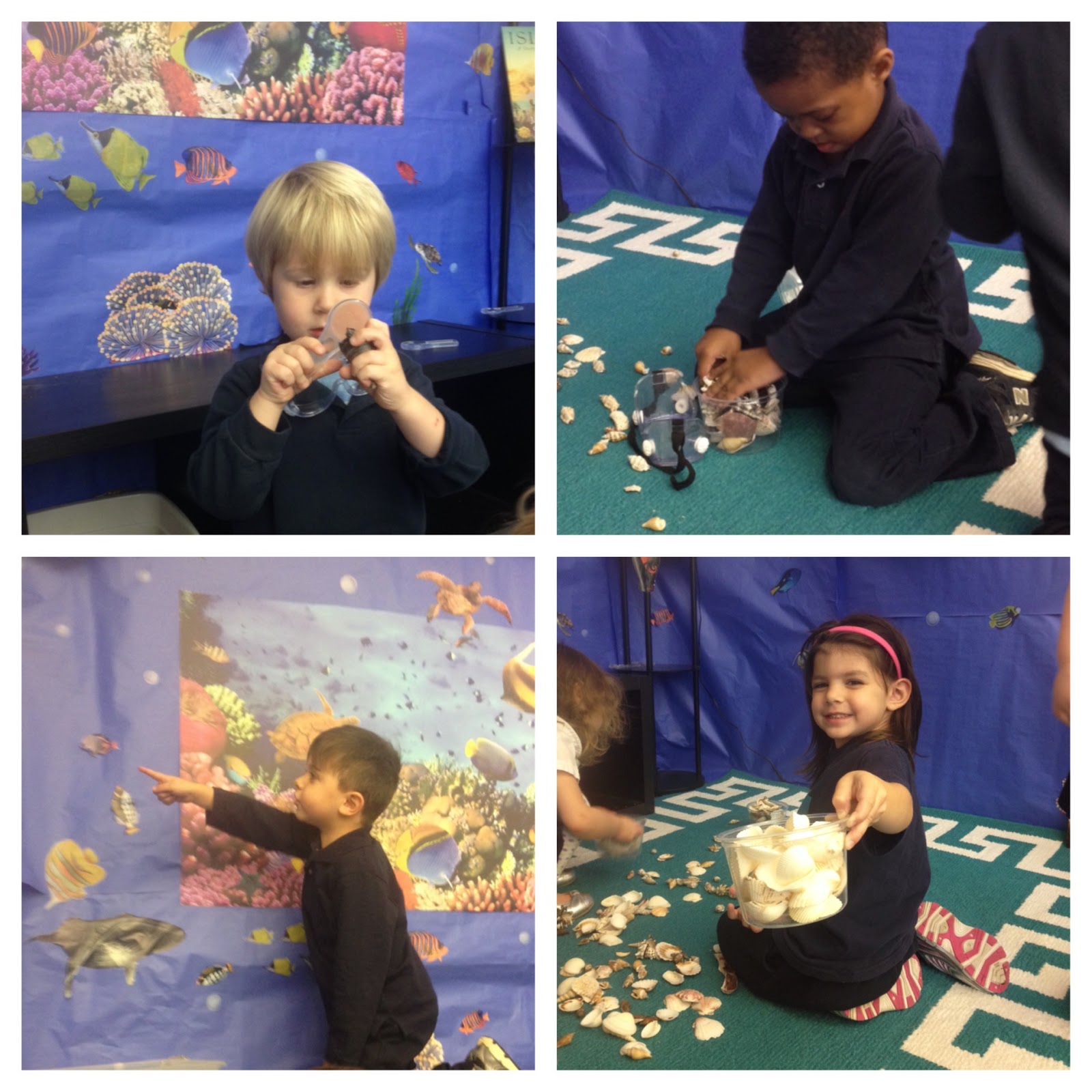
Listening to shells in "scuba mask"
When I create new units for our preschool through kindergarten classes, I often begin by asking them what they want to learn about. Their answers range from cheetahs to princesses, buildings to bugs. I then work to see what categories those items fall under, and what meaningful STEM-based learning experiences I can create to capture their interests.

It just so happened, that this time the students picked things that fell into two big categories.... the ocean and how things move. Our OCEAN AND MOTION unit was born! Because Kindergarten standards have an important unit on pushes and pulls  it was only natural that my classroom would become a world of oceans and motions for all preschool through Kindergarten students. At the same time, Donors Choose had a Chevron "Fuel Your School" partnership so I was able to purchase all of the ocean and motion materials we needed! Thank you to our additional donors as well!
Student reads "Coral Reefs" by Author Jason Chin who did a school visit!
Always great to have my husband take time off work to volunteer! "Shell balance" has been a favorite center
At the beginning of each class, we start with a motion song. This helps give the students vocabulary to explain the way things move, or patterns of their movement, as they explore in different sci-centers.

Even if students are in a center where movement is not explicitly explore (say making patterns in sand with shells) they can then explain the shape of the paths the shells made--zig-zag, curved etc.


Modeling sand + shells = awesome
"This is what it looked like after the water rolled over it"- 5yo

In Think Tank, students choose from sci-centers. Each center has an activity that is based on either oceans or the way things move... or both! Students are encouraged to explore, ask questions and collaborate to make the most of the experience. Who knew there was so much learning to be done with seashells alone!
                                    
                                                3 year old sorts seashells in the "ocean"


As students explore a concept, I also ensure they MUST do so together! My favorite part of the video below is not the engagement of the students, or the testing they are doing, but when I hear a students say, " Ok! Your turn!" Those collaborative skills are just as important as content goals!


Students will have a few more weeks to explore the world of oceans and motion before we head on our next adventure! If you want to come and visit and explore with us, the door is always open... just bring your flippers and scuba gear!

Up next? PARTNERSHIPS! From Beekeeping to US Forest Service, Author Jason Chin to Birds of Prey, partnerships have been in full swing!  Stay tuned!

Until next time,
Mrs. Ford


Monday, October 27, 2014

#ObserveEverything October

OBSERVE.... EVERYTHING!
2nd graders complete an #ObserveEverything challenge.
This month's work was inspired by one of my favorite programs on National Public Radio-- Science Friday. Science Friday has a Science Club online. For one month, they asked people to OBSERVE EVERYTHING... and Maury students did!

Observing our newly emerged Monarch!
My goal was to provide a context for students to work together to observe phenomena and draw conclusions based on their observations. I also wanted to make the data derived from these observations as REAL as possible, to have students not only observe but live the thing they were observing. For example, who wants to use a print out of last year's weather data when you can live the data anyway? Who wants to watch a time-lapse of food decomposing when you can live it happening each week?

                                      Lucy explains her observations about decomposing foods.

At all levels, students have been honing their observation skills! More importantly, they have used their observational findings and applied them to finding patterns, analyzing data, asking questions and working together to find solutions to problems! Each grade level has been involved in different projects so here are a few highlights.

                                          Kindergarten, 1st and 2nd Grades:
With the Next Generation Science Standards,  K-2 are expected to understand are that scienti

sts use different ways to study the world, look for patterns when making observations, and use drawings, sketches and models to communicate their findings. In Think Tank, students have had the chance to practice these scientific skills in various ways.


KINDERGARTEN OBSERVERS:
Kindergarteners have set up an experiment to see if worms make a difference in how fast a banana peel decomposes and predicted which of three foods would decompose fastest. Each week they make observations and check back at their original predictions.

Students are able to rotate around to various Sci-Centers in my class. Each center allows students to explore some aspect of science and engineering and boy do they love it!

In addition to our weekly class, students are tracking daily weather conditions. They made predictions about what kind of month we would have and we are watching closely to see if our predictions were correct


1st GRADE OBSERVERS:
 1st grade students have continued observing changes in their Wisconsin Fast Plants over time but have also started a classic Habit of Mind Think Tank Challenge: Contribute Positively to the Group and Inspire Teamwork to create a single structure. This is harder than it seems, but our 1st graders are up to the challenge.


They are practicing using positive words and voice to communicate their ideas and resolve conflicts surround design through discussion. Each week they improve. While they work, I pull groups to meet and do close observation of our plants so it's the best of both worlds: practicing the PRACTICE of problem solving in a group and working on a scientific phenomena in a small group.


2nd GRADE OBSERVERS:
As noted in my last post, this group has spent a lot of time looking very closely at their work and the PROCESS of that work. Last week they completed an #ObserveEverything Scavenger hunt. We were supposed to go outside to explore our schoolyard ecosystem but it was raining...again! Not a problem though, students were asked to look past the obvious in the classroom and OBSERVE EVERYTHING!
Students explore the classroom documenting their findings.

 Students each had a role: Researcher, Recorder, Photographer. They rotated jobs every 3 observations.

 
Their observations were detailed and interesting. I always find it fascinating to look through the "eyes" of my students. This challenge allowed for that with this group. Just check out their eye for macro photography!


3rd GRADE OBSERVERS:
This group continues to work with the amazing Toni Burnham of DC Beekeepers on exploring the fascinating world of honeybees. During our last class students got to use ALL 5 senses to explore the hives! 
While Ms. Toni was away last week we finally had a chance to delve into our weather wall. We have been recording air temperature at the same time every week since the 1st week of school. Students looked for temperature trends and then used those observations to make predictions for what the temperature will be like in 5 weeks!
Our data since the first week of school. Two classes = two data points!  

Student journal since week one.
                              Individual student predictions and the RANGE of our our predictions.

4th GRADE OBSERVERS:
This grade has spent the last month collaborating to explore levers and conducting experiments with them. 


They have conducted a fair test to determine if fulcrum placement in relation to the load and the effort makes a difference in the effectiveness of their catapult.
Students then used that knowledge to design a catapult from scratch that would send "Lego Ford" the farthest! 

 We will be finishing up this unit in the next week and after that.... ENERGY!

5th GRADE OBSERVERS:
 5th Grade continues to work hard to get themselves to SPACE CAMP! In fact, Astronaut Don Thomas visited us October 20th to share what it's like to live and work in space. His presentation was AMAZING and the students were enthralled! 4th and 5th got to participate:)


"We are never washing our hands again! They shook the hand of an astronaut!:

This visit really helped students add context to what we are studying in class too. They are finishing up an exciting Space Systems unit. In this unit they have explored the phenomena of day and night by traveling the globe using EarthCam.


They have started tracking monthly daylight changes over time and have started graphing their findings in their notebooks. Stay tuned for their observations and conclusions about the cause of these changes!
 
 They also took on a fun inquiry where they had to work together to graph stars based on their brightness and temperature. This week we will be analyzing our chart! ( They will soon figure out it is a


Now if it would only be sunning on a Wednesday we could conduct a fun shadow experiment. It hasn't been sunny on a Wednesday in 5 weeks!
  
SCHOOLWIDE MONARCHS:Lest we forget the many flying friends who emerged over the last month. In total, Maury sent off 25 Monarchs this year! Students watched each step eagerly and with anticipation and we had many beautiful send offs.
                                
                                                     Monarch emerging. AMAZING!

 WHAT ABOUT PRESCHOOL AND PRE-K???
 

Our youngest students are just finishing up exploring all of the exciting sci-centers Think Tank has to offer. We studied Monarch's in-depth and last week all students told me what they wanted to learn about next. From dinosaurs to space, oceans to plants and princesses to buildings, our 3 and 4 year olds are eager to learn. Our next study begins this week! We are studying HOW THINGS MOVE! This was the best way I could integrate their varied interests. Stay tuned to see us learn about how animals move, how the ocean moves, how people move and more!

FINALLY.....

Thanks to the amazing work of all your students, Science Friday asked me to come on their show on October 24th and discuss how we use observation in the classroom and why it's so important!  You can listen to the interview HERE! It's a great segment, but if you want to here me talk about your children, I start around the 11min20second mark:)

In the quietest place I could find for the interview... my car! Waiting for the call!
Until then,
Mrs. Ford