Extra-Vehicular Activity ( EVA ) fun! 1/6th gravity! (c)2014 Binomio
There are experiences in life that change you. They change the way you look at the world, the way you relate to things around you and that open your eyes and mind to possibilities. The Honeywell Educators @ Space Academy was one of those experiences for me.
Each year, Honeywell employees give to a fund that brings educators from around the world to Space Camp at the US Space and Rocket Center in Huntsville, Alabama. This week-long (fully-paid!) experience not only allowed me to step outside my comfort zone and try new things, it broadened my content knowledge about space, space-science and the future of space exploration.
Aviation Challenges: Zip Lines, Helo Dunker and more....
Preparing to enter the Helo Dunker which simulates a helicopter crash and (safe, successful escape).
This experience allowed me to bond with educators from around the country and the world and learn from each of my teammates and colleagues.
This broad range of cultures and experiences have now provided me with a network of inspired and dedicated educators to whom I can connect my students.
Ping, my roommate and teammate from China.
Teachers room with teammates. These members of Team Tranquility ( another team) are from Rhode Island, Kenya and Kazakhstan!
Skype dates are already planned for my classes with those in Dubai, Australia and Rhode Island, among others! The world literally will be opened for my students because of this.
Collaborative low-ropes team building.
There has been no professional experience in my recent past that has inspired me in the way that this one has. Prior to this experience, I included space science in my units but was limited to age and depth by my own lack of knowledge and experience. No longer!
Getting ready to present our "Deep Space Telescope Facility" plans. This lesson was amazing! Lunar bases are NOT science fiction and will eventually exist. We learned about what would be needed and had to create certain areas of our lunar base incorporating this knowledge.
This year, not only do I plan to share this experience with students based on workshops and lessons I tried at HESA, I aim to take our 5th grade students to Space Camp. In fact, I will shoot for the stars, and work to make going to Space Camp at Maury Elementary an annual 5th grade trip. Stay tuned as this dream develops for our students. ( Interested in helping fund this for our students or support our fundraising efforts? Please email me: vanessa.ford@dc.gov ).
Honeywell Educator @ Space Academy Team Harmony Mission Patch! Our 16 person team were represented by people from 8 countries! (Of course we had to include the HESA logo too, for without Honeywell, we wouldn't be there!)
For the remainder of this post, I will keep my words short and let videos of my experience "do the talking". You will first find a number of short videos or experiences I had at HESA. (To view a compilation video of the entire week, visit this link!). Please consider watching these videos with your child to get them excited about all that is to come next year! Enjoy and get ready to BLAST OFF during SY 2014-2015 to new frontiers of learning, thinking and problem-solving in Think Tank!
This Multi-Axis Turner (MAT) simulates the potential disorientation felt by astronauts should a capsule spin out of control upon re-entry.
During the week, we completed two mission simulations. Here, we watch in Mission Control while "Commander Patrick" attempts to land his shuttle safely prior to our official ( graded!) mission the following day!
What does it feel like to "walk" on the moon? Like this! Exploring 1/6th gravity with this special chair.
We completed MANY workshops about content and lessons we could bring back to our classes. This video shows our Martian Lander-Rover Challenge! We worked together to create a lunar lander that would get an egg safely to the ground, in a specific location while carrying a "rover". We then would use the rover to see whose went the farthest. The simplest designs won ( aka no ours) but it was still a great challenge and one that will definitely be used in Think Tank this year!
What does it really sound like in mission control? Here I worked with a team to provide information to our teams "on the moon" ( directly into their ear pieces). It is stressful!
And more from SOCR! Take a look at what the mission specialists are actually DOING in space!
We got a REAL graduation ceremony too! They take our name-tags and turn them from upside down to right side up! Speakers included astronauts, a senator and alumni from the 10 years of the program.
We then were celebrated... under a Saturn V rocket... with astronauts! What a week!
THANK YOU HONEYWELL EMPLOYEES!!!!! I have an open classroom and all are welcome to join us any day in our learning.
This blog post will share the students' process and also include their "promotional videos" created by each team's marketing folks!
"CARS VS. DRAGONS"
"EXTREME CHESS"
Labyrinth owner, Kathleen Donahue and game-designer and employee extraordinaire Judy Thomas created an 8-week unit that led students through all the complex facets of game-design, from initial idea to final product!
"FOX FIVE"
"HUNTERS"
Students had to each determine the role they would play in their 5 person teams:
"PRINCESS IN THE TOWER"
"HIDDEN TREASURE"
Then, after learning about theme vs. abstract games and game mechanics, students had to create a very rough outline for their design:
From there, the complexity of their designs developed. Depending on their role, they had specific work to complete and questions to consider:
Final games will be added to the Think Tank Lending Library for students to use next school year! "CLASH OF CLANS: DRAGONS AND PONIES"
"CODE BUSTER"
"MATH R' US"
THANK YOU Labyrinth and Capitol Hill Community Foundation! We hope to make this a 3rd grade unit each and every year!
As the year ended, we wrapped up a few GREAT projects and I left for the Honeywell Educator Space Academy. ( I'm still here actually!) When I return next week look for awesome pictures, videos and information about all of the great things that happened the last month of school.
What do you have to look forward to?
A blog post all about the amazing Wisconsin Fast Plants unit with Early Childhood!
You'll want to play all of the games our 3rd graders produced through our Labyrinth partnership.
You'll be blown away but the videos, pictures and learning gleamed from my time at HESA2014. Here is a video from Day 3 to tempt you!
And why not provide another. Today I was in SOCR ( Mission Control) for a lunar mission. Not only have we completed these simulations but we've also taken a number of workshops on lessons I can bring back. I can't WAIT for next year to learn with all of Maury's STEM lovers! This is a lesson we learned today based on systems created to put Curiosity on Mars!
So stay tuned Think Tank follower.... updates are coming soon.
As we near the end of the year, I wanted to find a way to connect and inspire learning for our youngest students into next school year.
The best way I thought to do this was through a sllloooowwwwlllllyyyy developing project that could have BIG impact on developing environmentalists! COMPOSTING!
Composters are on display in the front lobby. Stop by and make your own observations!
Students picked one recently living item ( a fruit ), one item made from something living ( paper ) and one non-living item ( glue stick, ping-pong ball, plastic bag respectively) and placed them in see-through composter. They then predicted which object would decompose first/ fastest.
Mrs. Wright-Spurlock's PK Class Votes
Ms. Timmons' PS/PK Class Votes
Mrs. Mitchell's PK Class Votes
Students will record their observations each of the next three weeks and I will take pictures of each container over the summer. In September 2014, the new Kindergarten class will be able to take out the contents of each section and explore if and how the objects decomposed. The connections of this mini-unit are endless as students begin understanding how humans can positively (and negatively) impact the environment with their actions.
What happens when you give 56 3rd graders the task of saving a town from certain environmental catastrophe? They rise to the occasion and do all they can to save it..with STEM!
Thanks to an amazing partnership funded by Raytheon for Engineering is Elementary (EiE) out of the Boston Museum of Science, Maury students are taking part in a variety of engineering units. I was also trained at an EiE Teacher Educator Institute, along side a great group of Einstein Fellows at NSF in January. All of that has led to what you are about to see: 3rd graders becoming environmental engineers!
Each of the EiE units begins with the question: What is technology? Students begin by brainstorming technologies and then looking more closely at things that they might not initially think of as such: plastic bags, paper clips etc. They come to the conclusion that technology is anything human-made that solves a problem or fulfills a desire. From there, they delve deeper into a specific engineering career, in this case, environmental engineering.
Students record information about their pieces of technology: paper clip and plastic bag.
To learn about this, all EiE units are framed in real-life context. For this unit, we learn from Teyha, a child in Washington State who witnesses the impact an oil spill has on her community and the ecosystem. Students look deeper into how interconnected ecosystems are and how imbalance in one area, even a small one, can have devastating, rippling effects. Through Teyha's conversations with her friend Thomas ( who lucky for us happens to be an environmental engineer), students learn along with her that environmental engineers use their knowledge of math, science and creativity to solve an environmental problem. She also learns about the Engineering Design Process (EDP) and how it helps engineers in their work. ( All EiE units use the EDP as the guide through each lessons. Students complete all steps in their work.)
The EiE Engineering Design Process graphic.
The book also introduces students to real life materials used to clean an oil spill, as well as any other content specific vocabulary they need for the unit.
Then comes the scientific testing! We turned to learning more about tests environmental engineers may actually use in their work by being introduced to the fictional city of "Greentown". Students receive a "letter from the Mayor of Greentown, informing them that the frogs and plants were dying in the town and they learn why!
Students explore pH and how acidic and basic soil and water can effect an ecosystem. The "mayor" then sent soil and water samples from various places around the town for students to test and use that data to determine why the frogs and plants were dying.
Students tested the samples from various places around Greentown and recorded their data, comparing it to the base data from 3 years ago. As a teacher, things don't always go as planned. Perhaps the samples I created were not done correctly, but as it turned out, our data wasn't where it "needed to be" to continue with the lessons. ( For example, the medicine factory soil showed an initial pH of 7.0 when, according to the curriculum it should have read 2.0). This was a perfect learning experience for us though!
( Small clip framing the day with the "Mayor" calling in at 00:50)
Here is the full "transcript":
I posted this letter but I also had my husband act as the mayor. Each time a letter was sent, we would get a voice recording "left on my phone" with our new assignment!
Our inconsistent data actually proved to be an excellent teachable moment! Students figured out, for example, that it was critical that they read the pH strips just after testing for the color changed as they dried, changing the resulting number. Our final data table is below.
Students then transferred this data into a visual map of their own in their journals, allowing them to SEE in a larger scale where the problem spots were and then were asked: "Which areas do you think are causing the frogs to die in Greentown Pond and the plants to die in Greentown Gardens"? They had to use their knowledge of pH, ecosystems, stormwater runoff AND information sent by the "mayor" to figure out the mystery.
The mayor of the city provided us with details about each area of the city to help us figure out what was causing the problems.
Here is an example of information students learned about one location in town.
Before students made their final recommendations to the Mayor of Greentown, I found it important to make connections to their real-lives, as well as provide more scientific information for them to use. In Greentown, one of the problem areas was where there was a road salt spill that was improperly cleaned up. During this unit, we happened to be in the middle of storm after storm, which made road salt ever present ( on the roads and literally all over the floor of our classroom). We took an additional class to look at this specific concern and after reaching out on Twitter, found two wonderful resources.
The first resource is a great animated short called " A Drop's Life" put out by DC Water. It is all about storm water runoff and why it is important to consider in a city like DC.
(This is really a brilliant 5 minute video! Watch it!)
At the same time, I contacted Martin Andres Austermuhle, producer at WAMU, the DC National Public Radio affiliate who had popped up on my twitter feed. It turned out he was running a story about this exact issue!
We even collected snow samples from our very own school grounds where salt had been spread and tested these samples to see how it made the water more basic!
With more information about the way pollutants can move through an ecosystem, plus real-life examples, students worked in teams to determine the main causes of frog and plant deaths. Groups shared their findings with the class and a few even called the Mayor. Again, kudos to my amazing husband for playing the part! ( I should note that at this point, students had figured out that my husband WAS the mayor, but it didn't change how excited they got about the project!)
Once again, current events played a large role in my lesson planning. In March, there was a large oil spill near Galveston, Texas. To frame the importance of their work, I had the Mayor send the following message to the students, asking them to help the Mayor of Galveston and the REAL scientists and engineers working at that very moment to save as much as the ecosystem as possible.
( I would email my husband the script, he'd record it and send back. I'd play his voice recording over the photographs of the spill. Sadly, I can't figure out how to imbed the audio!!)
Galveston, Texas boom from spill and birds effected.
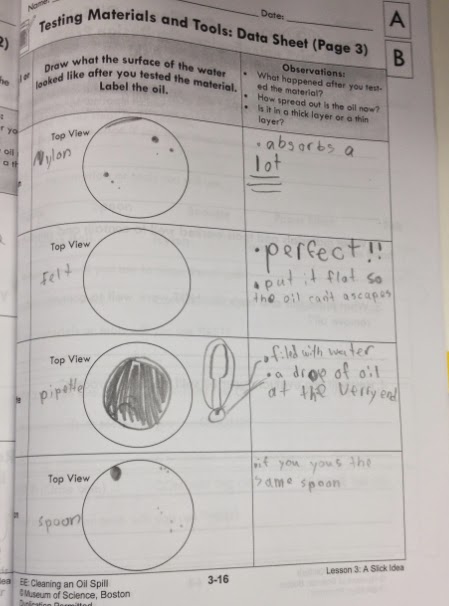
The third major step in this unit was to complete scientific tests to help inform their solutions. They had to complete controlled experiments with oil and a number of materials to determine how well each contained or absorbed oil.
With lots of help from parents and from a very special visitor ( Dr. David Evans, Executive Director of the National Science Teachers Association) students made predictions about if, and how well, 9 materials would absorb or contain oil.
Dr. David Evans introduces himself to the class before getting to "work" with our young scientists. (Photos courtesy of Robert Pohl)
Using "C" sign for contain, "A" for absorb in predicting what materials would do when in contact with oil.
Even with our best efforts, oil moved out of its ideal "blob". While this made controlling this variable more difficult, it was equally as much a learning moment for students to see how easily oil moves and spreads on water.
Testing each material. Recording results.
Example of student observations.
Once all materials had been tested, we came back in the next class and evaluated our methods and decided we had to test 5 of the materials again. After doing this, the class came up with the following:
The final step in this amazing learning odyssey, is for students to use this information to construct their own oil spill clean up devices. However, timing has it that....spring break happened...which is when I'm writing this update.
So what happens next? Well, when we return, this group of students will be embarking on their next unit, an amazing partnership in game design with Labyrinth Puzzles and Games. However, we can't just leave this data hanging without completing the final challenge! 92% of the 56 3rd graders have jumped at the chance to complete the final step in this learning process: making their own oil spill clean- up device using what they learned about the materials! Students will be coming to me for three extra classes (recess environmental engineer club) where they will complete this final step.
If our budding environmental engineers' work during this unit is any indication of the solutions they will create, I know they will show incredible scientifically grounded, creative solutions to this final challenge. Stay tuned for their amazing work!


.JPG)
.JPG)
.JPG)


.JPG)
.JPG)