As we near the end of the year, I wanted to find a way to connect and inspire learning for our youngest students into next school year.
The best way I thought to do this was through a sllloooowwwwlllllyyyy developing project that could have BIG impact on developing environmentalists! COMPOSTING!
Composters are on display in the front lobby. Stop by and make your own observations!
Students picked one recently living item ( a fruit ), one item made from something living ( paper ) and one non-living item ( glue stick, ping-pong ball, plastic bag respectively) and placed them in see-through composter. They then predicted which object would decompose first/ fastest.
Mrs. Wright-Spurlock's PK Class Votes
Ms. Timmons' PS/PK Class Votes
Mrs. Mitchell's PK Class Votes
Students will record their observations each of the next three weeks and I will take pictures of each container over the summer. In September 2014, the new Kindergarten class will be able to take out the contents of each section and explore if and how the objects decomposed. The connections of this mini-unit are endless as students begin understanding how humans can positively (and negatively) impact the environment with their actions.
What happens when you give 56 3rd graders the task of saving a town from certain environmental catastrophe? They rise to the occasion and do all they can to save it..with STEM!
Thanks to an amazing partnership funded by Raytheon for Engineering is Elementary (EiE) out of the Boston Museum of Science, Maury students are taking part in a variety of engineering units. I was also trained at an EiE Teacher Educator Institute, along side a great group of Einstein Fellows at NSF in January. All of that has led to what you are about to see: 3rd graders becoming environmental engineers!
Each of the EiE units begins with the question: What is technology? Students begin by brainstorming technologies and then looking more closely at things that they might not initially think of as such: plastic bags, paper clips etc. They come to the conclusion that technology is anything human-made that solves a problem or fulfills a desire. From there, they delve deeper into a specific engineering career, in this case, environmental engineering.
Students record information about their pieces of technology: paper clip and plastic bag.
To learn about this, all EiE units are framed in real-life context. For this unit, we learn from Teyha, a child in Washington State who witnesses the impact an oil spill has on her community and the ecosystem. Students look deeper into how interconnected ecosystems are and how imbalance in one area, even a small one, can have devastating, rippling effects. Through Teyha's conversations with her friend Thomas ( who lucky for us happens to be an environmental engineer), students learn along with her that environmental engineers use their knowledge of math, science and creativity to solve an environmental problem. She also learns about the Engineering Design Process (EDP) and how it helps engineers in their work. ( All EiE units use the EDP as the guide through each lessons. Students complete all steps in their work.)
The EiE Engineering Design Process graphic.
The book also introduces students to real life materials used to clean an oil spill, as well as any other content specific vocabulary they need for the unit.
Then comes the scientific testing! We turned to learning more about tests environmental engineers may actually use in their work by being introduced to the fictional city of "Greentown". Students receive a "letter from the Mayor of Greentown, informing them that the frogs and plants were dying in the town and they learn why!
Students explore pH and how acidic and basic soil and water can effect an ecosystem. The "mayor" then sent soil and water samples from various places around the town for students to test and use that data to determine why the frogs and plants were dying.
Students tested the samples from various places around Greentown and recorded their data, comparing it to the base data from 3 years ago. As a teacher, things don't always go as planned. Perhaps the samples I created were not done correctly, but as it turned out, our data wasn't where it "needed to be" to continue with the lessons. ( For example, the medicine factory soil showed an initial pH of 7.0 when, according to the curriculum it should have read 2.0). This was a perfect learning experience for us though!
( Small clip framing the day with the "Mayor" calling in at 00:50)
Here is the full "transcript":
I posted this letter but I also had my husband act as the mayor. Each time a letter was sent, we would get a voice recording "left on my phone" with our new assignment!
Our inconsistent data actually proved to be an excellent teachable moment! Students figured out, for example, that it was critical that they read the pH strips just after testing for the color changed as they dried, changing the resulting number. Our final data table is below.
Students then transferred this data into a visual map of their own in their journals, allowing them to SEE in a larger scale where the problem spots were and then were asked: "Which areas do you think are causing the frogs to die in Greentown Pond and the plants to die in Greentown Gardens"? They had to use their knowledge of pH, ecosystems, stormwater runoff AND information sent by the "mayor" to figure out the mystery.
The mayor of the city provided us with details about each area of the city to help us figure out what was causing the problems.
Here is an example of information students learned about one location in town.
Before students made their final recommendations to the Mayor of Greentown, I found it important to make connections to their real-lives, as well as provide more scientific information for them to use. In Greentown, one of the problem areas was where there was a road salt spill that was improperly cleaned up. During this unit, we happened to be in the middle of storm after storm, which made road salt ever present ( on the roads and literally all over the floor of our classroom). We took an additional class to look at this specific concern and after reaching out on Twitter, found two wonderful resources.
The first resource is a great animated short called " A Drop's Life" put out by DC Water. It is all about storm water runoff and why it is important to consider in a city like DC.
(This is really a brilliant 5 minute video! Watch it!)
At the same time, I contacted Martin Andres Austermuhle, producer at WAMU, the DC National Public Radio affiliate who had popped up on my twitter feed. It turned out he was running a story about this exact issue!
We even collected snow samples from our very own school grounds where salt had been spread and tested these samples to see how it made the water more basic!
With more information about the way pollutants can move through an ecosystem, plus real-life examples, students worked in teams to determine the main causes of frog and plant deaths. Groups shared their findings with the class and a few even called the Mayor. Again, kudos to my amazing husband for playing the part! ( I should note that at this point, students had figured out that my husband WAS the mayor, but it didn't change how excited they got about the project!)
Once again, current events played a large role in my lesson planning. In March, there was a large oil spill near Galveston, Texas. To frame the importance of their work, I had the Mayor send the following message to the students, asking them to help the Mayor of Galveston and the REAL scientists and engineers working at that very moment to save as much as the ecosystem as possible.
( I would email my husband the script, he'd record it and send back. I'd play his voice recording over the photographs of the spill. Sadly, I can't figure out how to imbed the audio!!)
Galveston, Texas boom from spill and birds effected.
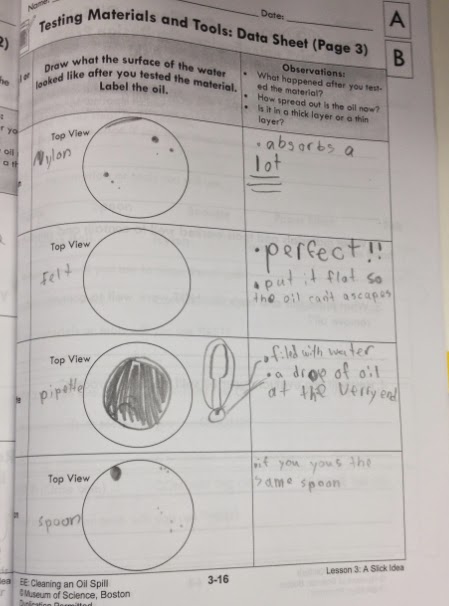
The third major step in this unit was to complete scientific tests to help inform their solutions. They had to complete controlled experiments with oil and a number of materials to determine how well each contained or absorbed oil.
With lots of help from parents and from a very special visitor ( Dr. David Evans, Executive Director of the National Science Teachers Association) students made predictions about if, and how well, 9 materials would absorb or contain oil.
Dr. David Evans introduces himself to the class before getting to "work" with our young scientists. (Photos courtesy of Robert Pohl)
Using "C" sign for contain, "A" for absorb in predicting what materials would do when in contact with oil.
Even with our best efforts, oil moved out of its ideal "blob". While this made controlling this variable more difficult, it was equally as much a learning moment for students to see how easily oil moves and spreads on water.
Testing each material. Recording results.
Example of student observations.
Once all materials had been tested, we came back in the next class and evaluated our methods and decided we had to test 5 of the materials again. After doing this, the class came up with the following:
The final step in this amazing learning odyssey, is for students to use this information to construct their own oil spill clean up devices. However, timing has it that....spring break happened...which is when I'm writing this update.
So what happens next? Well, when we return, this group of students will be embarking on their next unit, an amazing partnership in game design with Labyrinth Puzzles and Games. However, we can't just leave this data hanging without completing the final challenge! 92% of the 56 3rd graders have jumped at the chance to complete the final step in this learning process: making their own oil spill clean- up device using what they learned about the materials! Students will be coming to me for three extra classes (recess environmental engineer club) where they will complete this final step.
If our budding environmental engineers' work during this unit is any indication of the solutions they will create, I know they will show incredible scientifically grounded, creative solutions to this final challenge. Stay tuned for their amazing work!
Early Childhood + exploration + Space = INSPIRATION!
As I've learned from our amazing early childhood teachers , learning through play is critical in preschool and PreK. In DC, our youngest students start at 3 years old and see me once a week for science. For this unit, I wanted them to truly take part in owning our learning, while planning something that was developmentally appropriate. Taking my lead from the Creative Curriculum that our fabulous ECE teachers use, I had students brainstorm ideas and then vote. They came up with many ideas from rocks to unicorns. From there it seemed that their brainstormed ideas fell into three main categories: SPACE, ANIMALS and PLANTS. Then they voted.
A PreK student votes for which unit she would like to learn about next.
After all 5 classes voted, "SPACE "won" with plants a close second. ( Phew! That is how I needed things to go given our long winter!) From there, I wanted to ensure that students could experience, explore and be inspired by this abstract concept of "space" as much as possible and through dramatic play. Thus began the task of turning my classroom into "space". Our amazing music teacher, Mr. Rogers, helped me hang a the planets ( TO SCALE) and help turn my classroom into one where students could come and explore this abstract concept. Check out the movie of us putting the planets together HERE!
Then came the fun part. The students have entered the class each day, excited by our missions. We still have a few weeks to go in this unit, but take a look at some of our work thus far. Enjoy the journey with us!
( For video compilations of our exploration, click on any of the links below too!)
Tall rocket building, lunar rover driving, observations as seen from the shuttle and more!
Working together to complete space themed puzzles
Overall, this unit has been so inspiring... to me! Their excitement, awe, questions, thoughtfulness, collaboration and overall joy during this unit has been contagious! Interestingly, the National Society of Black Physicists began sharing our work on Twitter.
I was blown away when they noted that THIS AGE GROUP would likely be the first to be on a manned mission to Mars. To hear that my students, these little explorers, may follow this path only makes me more passionate to bring the sciences to our students. Read more about the NASA Mars Exploration Program here.
Might one of these children be the first?
In addition, I was recently selected to attend the Honeywell Educator Space Camp at the US Space and Rocket Center this June. It has always been a professional goal of mine to learn more about space science and it just so happened that my acceptance has coincided with our youngest learners' journey. I can't wait to bring back all I learn next year!
Finally, it seems that all the stars are aligning because my dear childhood friend and amazing author/illustrator Jason Chin is releasing his newest book called "GRAVITY" at the end of the month. While his books normally are for the 3rd-5th grade age, this one is perfect for our youngest learners.
Students draw the classroom to 1/2 scale ( 1 ft = .5in)
Our 4th graders are incredibly lucky to once again be part of the District Architecture Center's "Architects in the Schools" program. We are now half way through our partnershis and our amazing architects from HKS Inc. have provided meaningful, exciting lessons to our students. So far, our amazing architecture team is made up of Abigail Howard, Matthew Noe, Sara Sepanski and Mindy Goodroe. Over the course of 8 sessions, our budding 4th grade architects will design DREAM classroom for our youngest learners, the preschool and prekindergarten students!
Students have been using their sketchbooks during and between classes to keep their ideas!
Lesson One: What is Architecture? What do our clients need and want?
To get to know the wants and needs of our students, we began with
interviews! Listen to the great ideas our youngest Maury learners.
During the first lesson, "our" HKS architects introduced the project to the students: creating a DREAM classroom for our early childhood students! Each team would be in charge of designing one center (blocks, dramatic play, table toys, animals or library).
Not only did our budding architects listen to what their clients had to say, but they also observed them playing to get ideas. They took copious notes in their AIS program provided sketchbooks and began thinking about what could be included in this project.
Lesson 2: Scale!
This lesson introduced the students to the idea of drawing to scale. Using varying sized chairs as models and going on a measuring scavenger hunt, students gained a deeper understanding of the importance of the relationships between items in a classroom.
Students sit in three chairs to experience their relationship to scale.
Students then took their measurements and translated them into a drawing that was created at half scale! This task challenged them to use their picture, math and people smarts.
Students measure each chair to see how the dimensions change as they get larger.
HKS Architect Matthew, helps students draw the room to half scale.
Measuring the door to help understand scale.
Measuring the table and shelves during our scale lesson.
Lesson 3: Plan, Elevation and Section
Did you know that architects must be able to draw and create models of things from multiple perspectives?
Student looks at what Mrs. Ford would look like in PLAN view. (Plan is birdseye!)
Our great architects came ready to teach students all about how to look at things and draw them from varying perspectives.
Student drawings of each of the cups in PLAN view.
Using cups cut in different ways, actual models and examples of their every day work, students learned that there are very specific ways that architects relay their ideas to others. Other topics introduced included architectural symbols and line weight.
HKS Architects Abigail and Matthew give examples of their own work to inspire students!
Students draw the three cups in plan, elevation and section.
Lesson 4: Using our 5 senses to inspire design!
Have you ever thought that when designing a space you'd need to take into account how things would smell? How about how they sound? These are important considerations for architects! Students had mystery bags that held their "sense". They then collected inspiration related to that sense around the classroom and presented their ideas to the class. For example, those with "sound", found things such as marbles could be included in a room to provide our client with fun sounds. One group was inspired to make a "scratch and sniff" wall by exploring the smells that could be included in their space.
Students find items in the classroom that represent their ideas for what they could "SEE" in a dream early childhood class. Other students make notes in their sketch books about the items they chose to represent their ideas for "TOUCH". These included soft items, bumpy items and round items.
Students work with HKS Architect Abigail Howard discussing how to draw their ideas "in plan" versus " in elevation".
Using
inspiration from their senses activity, students get to work sketching
some of their new ideas for their space. These students considered
creating a "dragon table" that would feel smooth, look interesting and
could be used in the "table toys" center.
Over the next 5 weeks students will take all they have learned, each of their pieces of inspiration and apply it to creating models! Stay tuned for their work and their evidence of their learning!
Special thanks again to the District Architecture Center and our HKS Volunteers!!!


.JPG)
.JPG)
.JPG)


.JPG)
.JPG)




.JPG)
.PNG)
.PNG)


.JPG)


.JPG)


.jpg)
.JPG)


